Is Cycling Safe in Malaysia? What the Data Actually Says
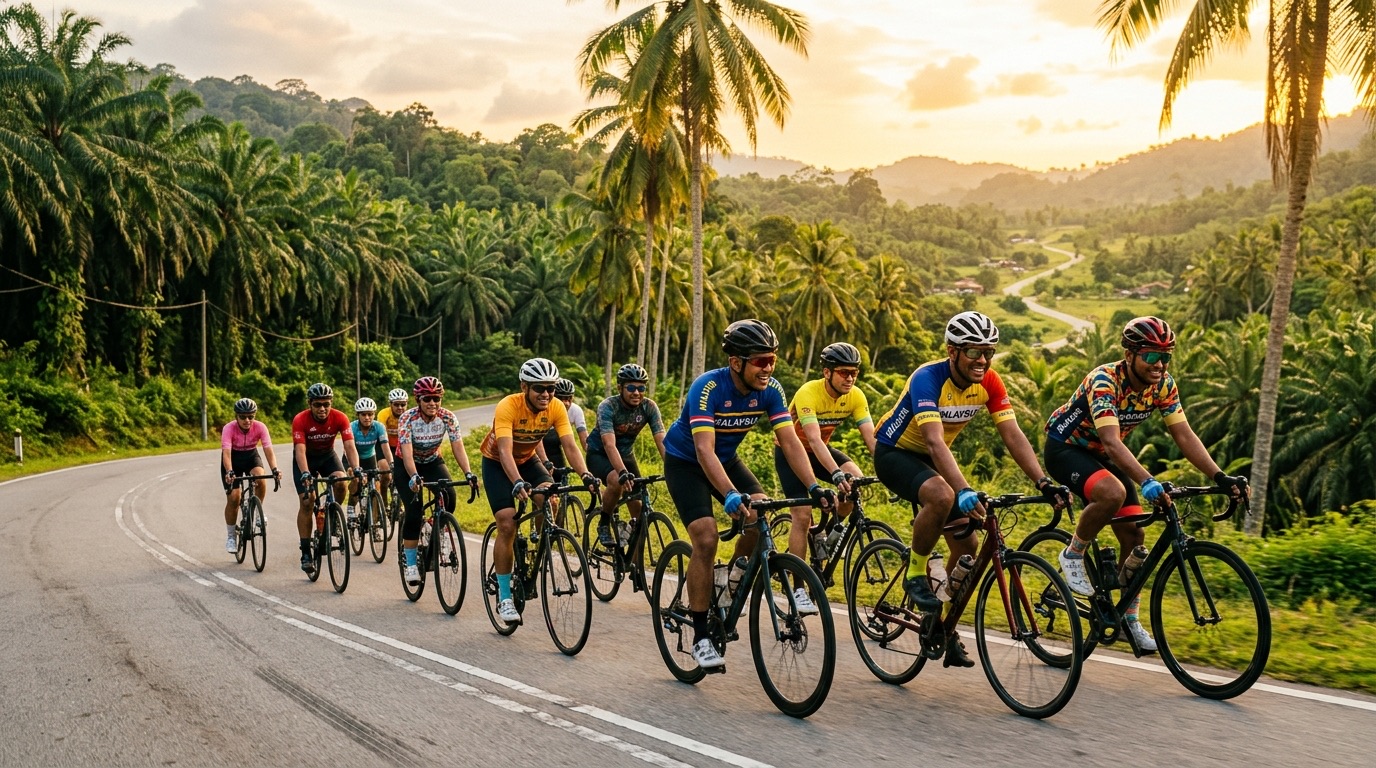
Cycling in Malaysia Is Booming, Here’s What You Should Know
Malaysia is in the middle of a cycling revolution. What started as a pandemic-era escape has become a permanent fixture of Malaysian life. Weekend group rides fill the roads from Putrajaya to Penang. Events like OCBC Cycle KL, Le Tour de Langkawi, and dozens of sportives across every state draw thousands of riders each year.
But as the community grows, so does the conversation around safety, and it gets loudest after a crash. If you have searched “is cycling safe in Malaysia”, whether you are a new rider, a returning cyclist, or a family member who would rather they stopped, this article gives the honest, sourced picture. Every number below is attributed, because most of the numbers thrown around in this argument are not.
Two Crashes That Framed the Argument
On the night of 20 August 2026, Mohd Hilmi Tahar, 48, and Syazwan Zharif Abdul Karim, 30, were killed at Km9 of Jalan Persiaran Selatan in Presint 5, Putrajaya. Police said the vehicle had moved from the middle lane to the left lane before hitting them. The driver was a local man in his 40s, and the case is under investigation under Section 41(1) of the Road Transport Act 1987.
On the morning of 4 September 2026, at about 8.30am, Zamrie Rismawadi Mahmet, 49, and Nik Zaki Yamani Nik Abdul Aziz, 49, were killed at KM18 of the Kota Bharu–Ketereh road in Kelantan, riding with seven friends on a routine they kept on public holidays. They were struck from behind by a car driven by a man in his 20s. Kelantan police chief Comm Datuk Mohd Yusoff Mamat confirmed the case is being investigated under Section 41(1) and appealed for dashcam footage.
Four riders, aged 30 to 49, in three weeks. In both cases the vehicle came from behind or changed lanes into them. Keep those two facts in mind, because the data below says they are the pattern, not the exception.
The Big Picture: Malaysia’s Roads
Malaysia recorded 6,537 road deaths in 2025, of which 4,340, or 66.4%, were motorcycle users, according to figures Transport Minister Anthony Loke presented to the Dewan Rakyat in January 2026. Motorcycles appear in only 13.7% of accidents but account for two-thirds of the deaths. For scale on crashes, police recorded 532,125 road accidents from January to October 2024 alone.
Cyclists are a small slice of that total. The Ministry of Transport’s cyclist safety page cites 2018 police data putting cyclist fatalities at roughly 2% of all road deaths, in a year with 6,284 deaths in total.
That 2% needs context. It reflects how few people cycle here relative to motorised transport. It does not tell you whether cycling is safe, it tells you there are not many cyclists in the sample.
What the Crash Data Tells Us
For actual cyclist counts, the clearest public figures came from Bukit Aman’s traffic investigation and enforcement department: 201 cycling-related crashes with 107 deaths in 2019, and 137 crashes with 56 deaths from January to October 2020, reported by Free Malaysia Today.
Look hard at that ratio. Roughly one in two recorded cycling crashes killed the cyclist. Part of that is a reporting artefact, since minor knocks involving bicycles often never reach a police report, so the recorded set skews severe. Part of it is simply physics: no crumple zone, no airbag, and no helmet that helps at 90km/h from behind.
A cycling crash in Malaysia is rare and close to a coin flip. That shapes what “safety” has to mean for a rider here: the goal is not surviving the crash, it is never being in one.
Where the fatal ones happen
The most useful Malaysian research is Exploring Cycle Crash Characteristics in Malaysia, published in MATEC Web of Conferences in 2017 and built on police crash investigation data held in the MIROS database. Cyclist casualties fell steadily from 2009 to 2014, with crash involvement down 49% and fatalities down 42%. The recurring risk factors it identified:
- riders over 60
- federal and state roads, not city streets
- straight road sections, not junctions or corners
- rural areas and small towns rather than urban centres
- evening peak hours
- collisions mainly involving cars and motorcycles
The straight-section finding is the one worth sitting with, because it contradicts intuition. We brace for junctions and roundabouts, where paths cross and somebody has to yield. But the crashes that kill happen where nothing was supposed to happen: an open, straight road, a driver travelling the same direction you are, several seconds of clear sightline. Those are not crashes of complexity. They are crashes of attention. Set the two 2026 crashes against that list and they fit it exactly.
The uncomfortable implication: route choice and good habits reduce your exposure a great deal, but you cannot ride your way out of a driver who never looked up.
Where Malaysia Is Getting It Right
It is easy to focus on gaps, but several things genuinely work:
- Putrajaya has dedicated cycling paths and regularly hosts cycling events, and remains one of the most pleasant places to ride in the country
- Penang has invested in cycling tourism infrastructure along its coastline and heritage areas
- Kuala Lumpur has introduced bike lanes in selected areas and expanded park connector paths
- Event organisers consistently run well-marshalled rides with safety briefings, support vehicles and emergency protocols
- Cycling communities self-organise safety practices, group ride etiquette, route sharing and incident reporting
Where There Is Room to Grow
Three concrete gaps, all fixable, none of which requires a single cyclist to change behaviour.
No minimum passing distance. Many countries require drivers to leave 1.5 metres when overtaking a cyclist. Malaysia has no such rule, so passing at 30cm is not an offence in itself. A safe-passing rule is cheap to legislate, easy to teach in driving schools, and gives both police and dashcam footage something specific to prove.
Almost no guidance aimed at drivers. The government’s 46-page Safe Cycling Guide (Ministry of Transport and MIROS, January 2022) is a genuinely good document, and it is addressed almost entirely to cyclists: how to fit your bike, how to signal, how to ride in a group. The MOT’s cyclist safety page tells cyclists to stay alert and acknowledges that Malaysian motorists are unused to cyclists. Neither tells a driver how to pass one.
No usable current data. The clearest cyclist-specific fatality counts in the public domain are from 2019 and 2020. There is no published annual figure for how many cyclists died on Malaysian roads last year, and cycling data is scattered across MOT, PDRM, MIROS and academia. You cannot set a target for a number nobody publishes, or prioritise infrastructure without knowing where riders are being killed.
Malaysia also has no national cycling infrastructure framework comparable to the Netherlands or Singapore, and protected lanes remain the exception. That is what turns “ride somewhere safer, then” from advice into an unanswerable question outside a handful of towns.
How to Ride Smarter in Malaysia
None of the above helps you tomorrow morning. These things do. Several are also legal requirements, which we cover in detail in what Malaysian law actually says about cycling on roads.
Pick Your Routes
The single biggest factor you control. Avoid high-speed trunk roads. Stick to secondary roads, residential areas and established cycling routes. Putrajaya, Cyberjaya, Taman Botani and park connectors are popular for good reason. Check our route guides for cyclist-tested roads across every state.
Be Seen
Front and rear lights are legally required after dark under Rule 35 of the Road Traffic Rules 1959, and they are the best value daytime safety equipment there is. Daytime running lights are standard practice in countries with far better records than ours. Bright kit and reflective elements are not optional extras here.
Ride Predictably
Hold your line. Signal turns. Avoid sudden swerves. Malaysian drivers may not be expecting a cyclist at all, so the more predictable you are, the safer the interaction.
Ride Single File
Not just on busy roads: Rule 42(3) requires cyclists to ride in single file, full stop, and it is the single most cited grievance drivers have against us. The Safe Cycling Guide adds the group detail: at least a metre between riders, split large groups into smaller ones, and leave roughly a kilometre between groups so traffic can get past. Designate a ride leader and a sweep, and use hand signals for hazards.
Gear Up
Helmets are not compulsory under Malaysian law, and you should wear one anyway. Gloves protect your hands in a slide, and glasses protect your eyes from debris and insects, a surprisingly common cause of incidents.
Run a Rear Camera
If you ride the same roads every week, this is worth the money. In the Kelantan case police publicly appealed for dashcam footage. Evidence is what turns a hit-from-behind into a prosecution rather than an unresolved file.
Know Your Events
Organised events are one of the lowest-risk ways to ride on Malaysian roads. OCBC Cycle KL and PERKESO Run & Ride offer marshalled routes, road closures and support, a different risk category from a bunch ride on an open trunk road. See our events calendar.
The Bottom Line
Cycling in Malaysia carries real risk, and the risk is concentrated somewhere specific: fast, straight federal and state roads where a driver’s attention has drifted. Choose your roads well, be lit, ride single file, ride predictably, and you remove most of your exposure to it. Hundreds of thousands of Malaysians ride every week without incident.
What the data does not support is the conclusion that reaches the comment section within an hour of every crash, that the deaths belong to the cyclists for being there. A driver whose attention wanders far enough to hit two people on a straight road in daylight is a hazard to everyone using it. Remove the cyclists and that driver is still out there, now aimed at a motorcyclist, a stopped car, or a road worker.
Ride carefully out there. And when you are the one driving, look further up the road than you think you need to.
Ringkasan (Bahasa Melayu)
Malaysia mencatat 6,537 kematian jalan raya pada 2025, dengan 66.4% melibatkan penunggang motosikal. Penunggang basikal pula kira-kira 2% daripada jumlah kematian jalan raya (data polis 2018, Kementerian Pengangkutan). Angka PDRM Bukit Aman: 201 kemalangan basikal dengan 107 kematian pada 2019, dan 137 kemalangan dengan 56 kematian dari Januari hingga Oktober 2020. Ertinya hampir satu daripada dua kemalangan basikal yang direkodkan berakhir dengan kematian.
Kajian kemalangan basikal (MATEC Web of Conferences, 2017, berdasarkan data polis dalam pangkalan data MIROS) menunjukkan risiko maut tertinggi berada di jalan persekutuan dan jalan negeri, di bahagian jalan yang lurus, di luar bandar, dan bukan di persimpangan. Kemalangan maut bukan berlaku kerana keadaan jalan yang rumit, tetapi kerana hilang tumpuan pemandu di jalan lurus yang terang. Dua kemalangan pada 2026, di Putrajaya (20 Ogos) dan di KM18 Jalan Kota Bharu–Ketereh (4 September), menepati corak itu: dirempuh dari belakang atau kenderaan bertukar lorong.
Untuk penunggang: pilih jalan yang sesuai, pasang lampu depan dan belakang (Kaedah 35), berbaris sebaris (Kaedah 42(3)), kayuh secara boleh dijangka, dan pertimbangkan kamera belakang sebagai bukti. Untuk negara: Malaysia masih tiada undang-undang jarak memotong minimum (banyak negara mewajibkan 1.5 meter), tiada panduan rasmi untuk pemandu, dan tiada data kematian penunggang basikal yang diterbitkan setiap tahun.
Sources: The Star, Motorcyclists make up two-thirds of road deaths in 2025; Ministry of Transport, Cyclist Safety; Free Malaysia Today, 137 cycling accidents until October, 56 killed; Exploring Cycle Crash Characteristics in Malaysia, MATEC Web of Conferences (2017); Ministry of Transport & MIROS, Safe Cycling Guide, January 2022; paultan.org, 532,125 road accidents January to October 2024; The Sun, Two cyclists died after being hit by vehicle in Putrajaya; The Star, Two cyclists killed in highway crash; Buletin TV3, Dua lelaki maut dirempuh kereta ketika aktiviti berbasikal.
Have questions?
DM us on Instagram for personalised cycling advice.
Message on Instagram